

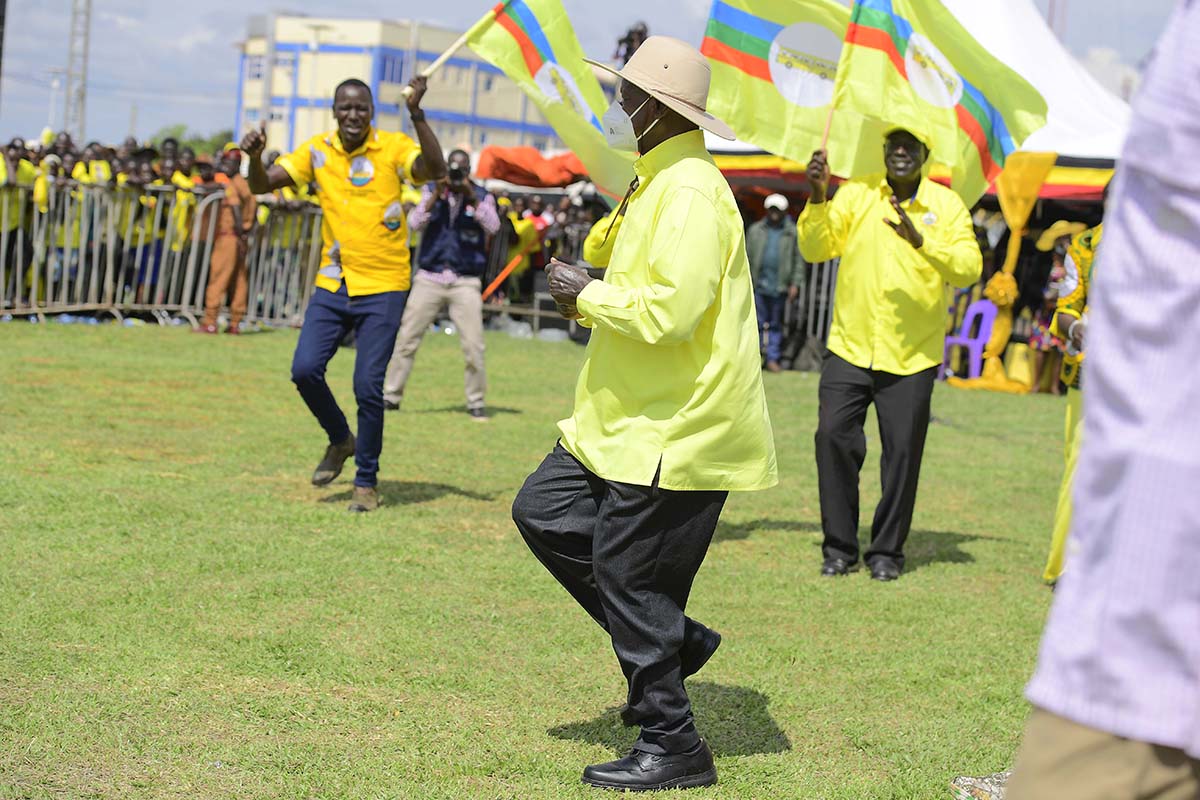

The speech that presidential candidate Yoweri Museveni gave in Otuke district on 3 October 2025 as he barnstormed the Lango subregion saw him pack a lot of information in such a short time. Certainly for an octogenarian. The reportage of the state-owned New Vision newspaper, given a fairly unimpeded view of the incumbent when juxtaposed with Daily Monitor, which is still serving out a months-long ban, was vigorously robust.
Yet the mask of neutral concentration slipped off on multiple occasions in the muscular reportage. One such occasion was when, in promoting himself as a leader who takes long-term decisions for the national benefit, candidate Museveni talked with great clarity about the political steps for the empowerment of women untaken on his watch. He said thus: “We don’t believe in the division of tribes or religion or in looking down on women or the youth. Everyone is valuable. In 1962, Uganda had only three women in Parliament, yet women are 50 per cent of the population. We have since changed that.”
A superficial reading of the claim does not get red flags flying. Not by any stretch of imagination. As a matter of fact, even amongst those for whom support to Uganda’s president since 1986 has been inconsistent and at times reluctant, the supportive arm Museveni has placed round the shoulders of Ugandan women is hard to miss. The numbers, with such a degree of equanimity, offer support. A lot of it. As Aili Mari Tripp notes in a peer-reviewed journal article, “in February 1962, Sugra Visram, Florence Lubega, and Eseza Makumbi were elected to the Buganda parliament.”
Noticeably, women found themselves having a newfound dimensionality when Museveni took over the presidency in 1986. Consequently, they stretched the limits of what could be considered possible.
“The number of women in political office remained low until the takeover of President Yoweri Museveni in 1986, when Uganda became a leader in Africa in advancing women in positions in the legislature and executive. The Museveni government’s adoption of reserved seats for women at all levels from local councils to the parliament in 1989 ensured that at least one-third of seats were held by women,” Tripp noted in her peer-reviewed journal article.
“The increase in numbers of women in parliament had some impact on the adoption of women’s rights legislation; however, ultimately women remained constrained by patronage and the undemocratic nature of the political system in Uganda,” she further offered.
Tripp’s candour, captured by the manner in which she asterisked gains made with an adverb—however, disturbs the equilibrium in ways that Museveni would not have wanted his audience in Otuke to know. The press is duty-bound to drill through this veneer.
To be clear, the veneer—fortified by numbers the Uganda Women Parliamentary Association (UWOPA) references—shows, for instance, that women lawmakers make up 34 per cent of 529-strong 11th Parliament. This includes 146 District Women Representatives (DWR); 16 directly elected constituency representatives; and three female army or UPDF representatives. Others are: two female workers representatives; two female youth representatives; three persons with disabilities (PWDs); three older persons representatives; and 14 ex-officio members.
The numbers should not be taken at face value. In her monograph on gender and parliamentary politics in Uganda, entitled When Hens Begin To Crow, Prof. Sylvia Tamale talks about “how the social reproduction of gender in female (and male) parliamentarians reproduces the gendered political structures.” The right of women to participate in politics as autonomous actors, she adds, “is still greatly curtailed in both overt and covert ways.”
In fact, Museveni is often accused, with some justice, of angling himself to benefit from so-called state feminism. Tabitha Mulyampiti has addressed this subject matter extensively and its attendant perfunctory or symbolic effort reducible to tokenism. She simply defines state feminism as the “political co-optation of women’s rights discourse.” Hardheaded cynicism and political calculation play a significant part in the state co-optation of feminism. Museveni’s fisherman cabinet that pushed women representation from 27 per cent to 43 per cent following his re-election in 2021 shows as much. It remains tokenistic despite or in fact because of appointments of the likes of Jessica Alupo and Robinah Nabbanja to the senior positions of Vice President and Prime Minister respectively.
Our ruling
Candidate Museveni told New Vision: “In 1962, Uganda had only three women in Parliament, yet women are 50 per cent of the population. We have since changed that.”
This, though, as we have gone to great lengths to show, is a classic case where more meets the eye. A nuanced picture emerges that demands more than just simplicity in the decoding process.
We therefore rate candidate Museveni’s statement Partially True.
_____________________________________________
Our sources
Tabitha Mulyampiti, State Co-optation Of Feminism: Unpacking The Paradoxes Of Political Representation, 2024
Sylvia Tamale, When Hens Begin To Crow, 1999
Aili Mari Tripp, Women in Ugandan Politics and History: Collective Biography, 19 November 2020
The New Vision, Museveni Pledges Oil Revenue For Development, 3 October 2025
Uganda Women Parliamentary Association, Statistical Data of Female MPs of the 11th Parliament