


Every Wednesday and Thursday, Uganda’s specially constituted wildlife crimes court comes alive with activity. Chief Magistrate Gladys Kamasanyu, or two other judicial officials, preside over cases from across the East African country, in the only court in Africa assigned primarily to handle wildlife offences.
On 12 February 2026, the Court, based in the Kampala suburb of Makindye, heard a case in which Gift Kusemererwa, a Uganda Wildlife Authority (UWA) ranger attached to Murchison Falls National Park, used evidence gathered with the help of real-time tracking and data analysis tools to place the five suspects before Kamasanyu at the scene of a crime committed at the park.
The accused quintet — Oyirwoth Kizito, Denis Ofoyuru, Robert Oyungrwoth, Alex Owonda, and Waningom Orama — are charged with three offences: entering a wildlife protected area without permission, unlawful killing of a young elephant, and transfer of a wildlife protected specimen.
As part of the evidence she adduced before the court as a witness, Kusemererwa logged Global Positioning System (GPS) coordinates from an open source surveillance platform called EarthRanger into a laptop provided by the court to show that the suspects were at the crime scene on the date and time indicated in the charge sheet.
The case against Oyirwoth and his four alleged accomplices was still ongoing by mid-April, when this story was finalised. However, the Wildlife Court has already disposed of more than 2,500 cases since it was formed in May 2017, with at least 600 convictions registered.
Annet Tuheisomwe, the head of the prosecution unit at the Uganda Wildlife Authority (UWA), the agency responsible for the management and protection of wildlife in and outside Uganda’s protected areas, told this publication that they have reaped a success rate north of 80 per cent in cases where they have depended on EarthRanger observation tech for evidence gathering.
EarthRanger functions as an integrated surveillance ecosystem. GPS collars on elephants and lions feed live data into ranger smartphones; drones conduct several unmanned patrols each day (at least four daily at Murchison Falls National Park); and hidden camera traps and acoustic sensors monitor hotspots. All of this information flows into joint command centres and a central hub in Kampala, creating a digital dragnet that tracks animal movements or conditions, ranger patrols, and other monitored park activity in real time.
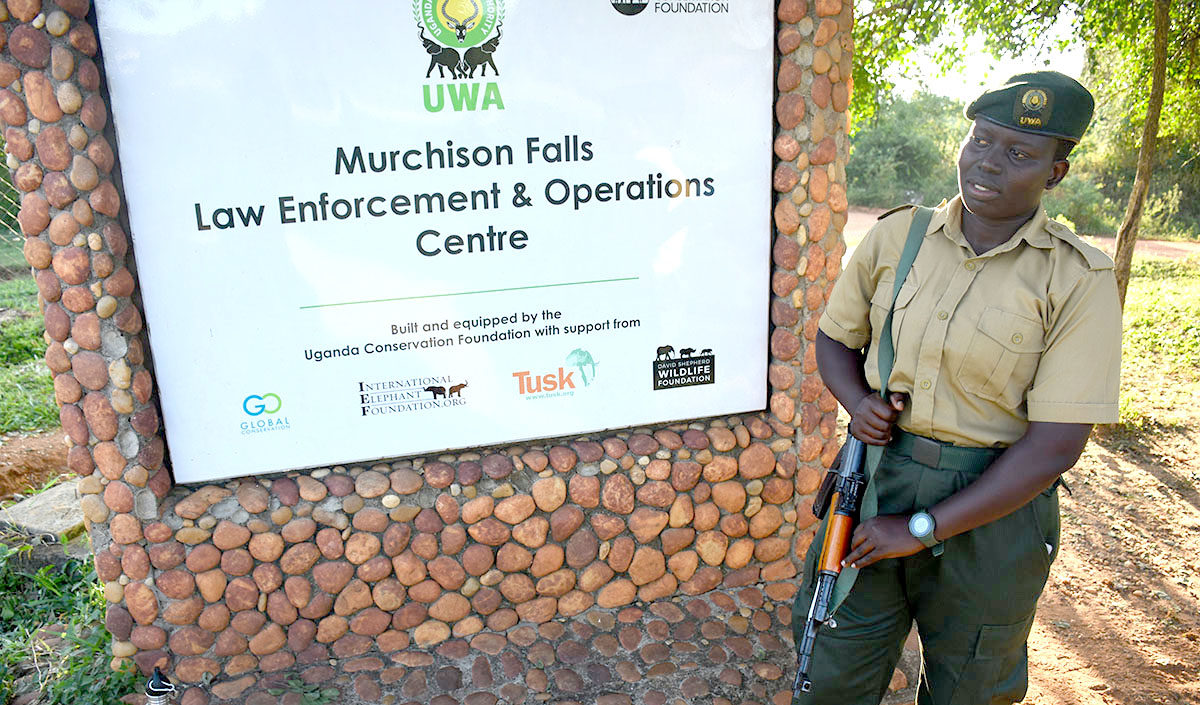
In 2021, UWA started using the integrated EarthRanger system, a donation from the Allen Institute for Artificial Intelligence (AI2), a US-based research institute founded by a Microsoft co-founder, via its partnership with the Uganda Conservation Foundation and CITES’ Monitoring the Illegal Killing of Elephants (MIKE) Programme.
The technology was first deployed at Murchison Falls National Park. Since then, according to UWA’s Head of Law Enforcement and Operations Division, Margaret Kasumba, EarthRanger has also been installed at Queen Elizabeth National Park, Kidepo Valley National Park, and Pian Upe Game Reserve.
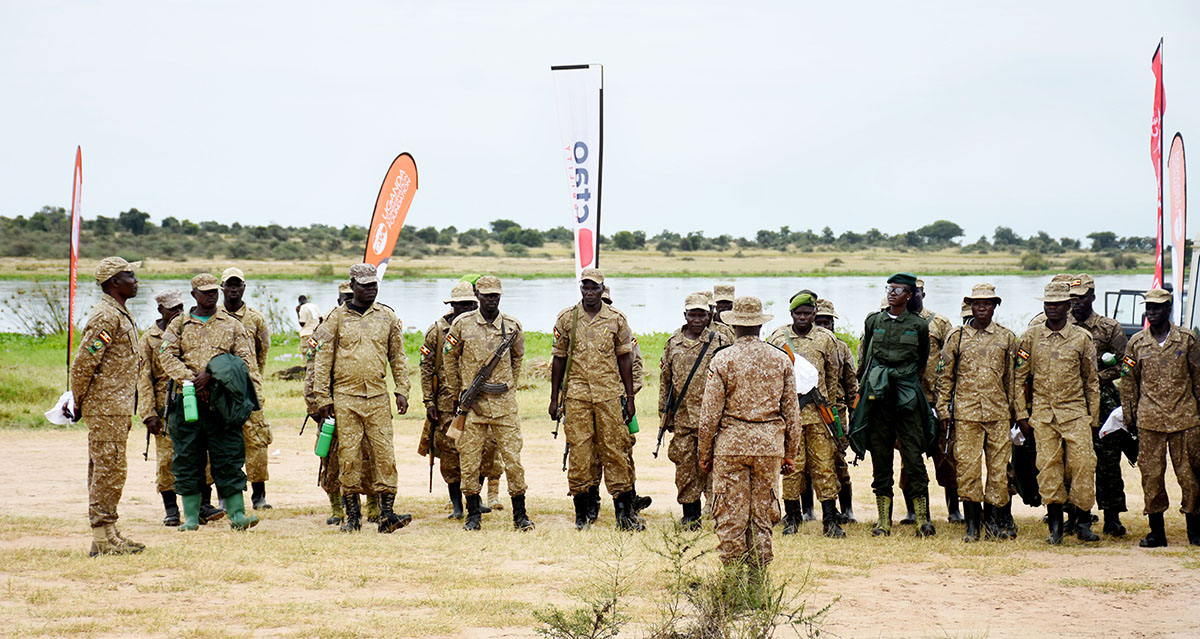
At each park, UWA operates regional joint operations command centre (JOCC) to gather real-time data from patrolling ranger equipped with smart phones, GPS-collared wild animals such as lions and elephants, and other aerial surveillance equipment like drones, which make at least four unmanned patrols daily, according to rangers who spoke to this publication on condition of anonymity since they are not authorized to speak to the press.
Information from the various regional JOCCs is then transmitted to a central hub at UWA headquarters, where integrated monitoring of operations across the national parks where EarthRanger is currently operational is conducted.
According to Kasumba, the government and its partners are set to install EarthRanger tech in another four national parks, though she did not specify a timeframe even after repeated queries by this report. We could not independently establish the timeframe for this activity.
“We are planning to roll out [EarthRanger] in other parks, including Bwindi [Impenetrable National Park], Mgahinga [Gorilla National Park], Lake Mburo National Park, and Kibale [Forest National Park], resources allowing, of course,” she said.
If UWA successfully implements its plan, as outlined by Kasumba, it will mean 60 per cent of Uganda’s 10 national parks will have EarthRanger technology, which Tuheisomwe said is set to become their “main tool for that kind of information.”
“Previously, we had SMART [Spatial Monitoring and Reporting Tool], ODK [Open Data Kit] and so many other systems. But now we are all saying EarthRanger is our main tool,” she explained. “Everyone else should put their feed into that so that we are able to analyse everything at once.”
Some of the tech at the park that UWA has either integrated or plans to integrate into its EarthRanger platform include long-range thermal cameras for observing activity at hotspots for illegal activities, digital and satellite communication systems, trackers for both animals and equipment, and vehicle speed monitors.
However, in Uganda’s highly militarized conservation landscape, the deployment of advanced data-aggregation platforms like EarthRanger illustrates the profound dual-use risks of modern eco-surveillance. Built to act as a centralized hub, EarthRanger utilizes an integration engine called Gundi to seamlessly ingest over 100 streams of real-time data, syncing everything from wildlife GPS collars and camera traps to the continuous geographic tracking of vehicles and field personnel.
While its real-time “analysers” — which trigger instant WhatsApp or SMS alerts for “proximity” breaches and “geofence” crossings — are designed to intercept poachers, they may inadvertently turn protected areas into sprawling digital dragnets. Experts, like Dr Rosaleen Duffy, a professor at the University of Sheffield, warn that because conservation NGOs frequently lack the training to secure this data, they risk “hoovering up enormous amounts of information” that allied state security forces and military partners can easily co-opt to monitor innocent civilians, track community movements, and suppress dissent under the sanitized guise of biodiversity protection.
Money Matters
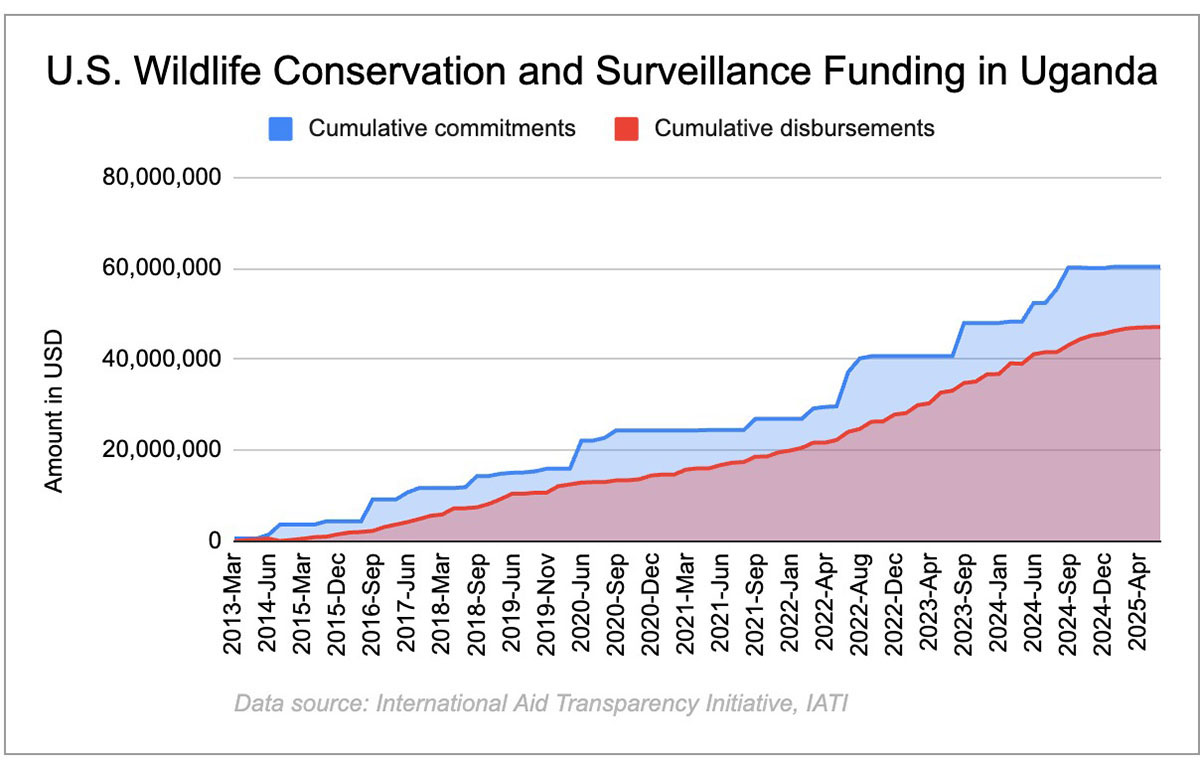
To develop its comprehensive wildlife conservation surveillance infrastructure, Uganda has received considerable funding from its allies in the United States of America and Europe. For instance, according to data from the International Aid Transparency Initiative (IATI), the East African nation received a total of nearly US$110 million from states and non-state actors in the United States alone between March 2013 and April 2025. Significant amounts of that money went into funding conservation and surveillance activities at the country’s various national parks and game reserves.
On April 20, 2026, the United States Department of the Interior responded to a freedom of information request by this publication, acknowledging that between January 1, 2024 and August 26, 2025 alone, Uganda received $2.7 million from the US government for, among others, “conservation programs in Uganda involving surveillance technologies, drones, AI tools, or security contractors.” The three-page letter was signed by Debosree Jayaram, a Government Information Specialist at the Office of the Secretary in the FOIA Office.
The largest allotments of the funds from the US authorities included $1,353,953 for “deploying digital evidence exploitation specialists (DEESs) to combat wildlife trafficking,” $788,121 for “deploying digital evidence exploitation specialists (DEESs) to combat flora and fauna trafficking,” and $347,765 for a “partnership to end wildlife trafficking in East Africa.”
Meanwhile, the European Union has built ranger outposts in Uganda’s national parks in recent years, while the United Kingdom donated £10m to fight wildlife trade in 2013 and then built a brand new armoury and secure storage facility at Queen Elizabeth National Park in 2016. On the other hand, UCF has implemented a $5 million project, funded by the European Nature 2000, to upgrade technology and build the capacity of rangers, among others, at Kidepo Valley National Park.
The Head of Communication and Public Relations at UWA, Bashir Hangi, conceded in an interview that substantial sums of money to support Uganda’s battle against wildlife crime have come from foreign backers, including France, the US, the UK, the Netherlands, and Italy, among others. He adds that the money has largely been used for enhancing conservation capacity and not militarization of conservation, even if portions of the money are going into purchasing surveillance equipment and building weapons storage facilities.
“The issue here is not militarising conservation, as you put it; it is more to do with enhancing our capacity to be able to encounter the threats. The threats to wildlife are real. You don’t expect someone to come with a spear to kill an elephant. Someone who wants ivory comes with guns, so the issue is, how prepared are we to counter them? How set are we for the task? This is exactly why we’ve received all this support: to ensure that we are up to the task,” he argued.
But even after that multimillion-dollar injection of foreign financing towards surveillance of conservation areas over the past dozen years, Ugandan authorities are not yet sated. They are also reaching into the local revenue pool.
On 27 January 2026, the government submitted a request to Parliament for US$2.6 million from locally sourced finances to buy a helicopter in the 2026/2027 financial year, which starts this June. Submitting the request to Parliament’s Committee on Trade, Tourism and Industry, the Undersecretary at the Ministry of Tourism, Wildlife and Antiquities, Geoffrey Sseremba, said the aircraft will improve aerial patrols at the national parks.
“This money is for buying a new helicopter, not maintenance,” he said. “It will help in conducting patrols, surveillance, and rescue operations, particularly of animals that have been ensnared by poachers.”
Asked why UWA needs another helicopter, given that it already has one used for surveillance and animal census activities, the wildlife protection agency’s spokesperson, Hangi, said they urgently need to improve the scope and speed of their interventions. “Once we have the helicopter, it will be very easy [to carry out] quick deployment and rescues,” he stated.
Army Alongside Rangers
In addition to surveillance technology, Uganda currently deploys at least 2,000 game rangers across its 10 national parks, 12 wildlife reserves, five community wildlife management areas, and 13 wildlife sanctuaries. A 2022 UWA report said Uganda had a one ranger to 30 square kilometre ratio at the time, far below the internationally recommended one ranger to 5-10 square kilometre ratio.
According to Hangi, the ranger numbers remain inadequate to this day, and plans are underway to recruit more conservation officers because “the technology enhances the work of the rangers, but it is not replacing human beings.” Indeed, in February 2026, UWA announced vacancies for 850 new rangers.
“We do not have sufficient numbers [of rangers],” he said in an interview. “The numbers we have are still small. Maintaining the same numbers is not enough because technology will tell you where there is a threat, but technology will not go there to remove the threat. You need manpower to go and remove the threat. You need boots on the ground, guys to run through the thickets,” he argued.
Under the Uganda Wildlife Act, 2019 (Act No. 17 of 2019), Parliament formally designated UWA as a paramilitary agency, authorizing military‑style training and the arming of rangers with combat‑grade weapons.
Owing to that status, UWA works closely with the Uganda People’s Defence Forces (UPDF) in joint operations and intelligence sharing. At Murchison Falls National Park, UWA’s ranger training school sits less than 200 metres away from a UPDF detachment. This proximity between the two institutions’ armed units risks introducing the trainee rangers to the army’s more combative methods of dealing with adversaries, which then become part and parcel of Uganda’s wildlife protection ecosystem.
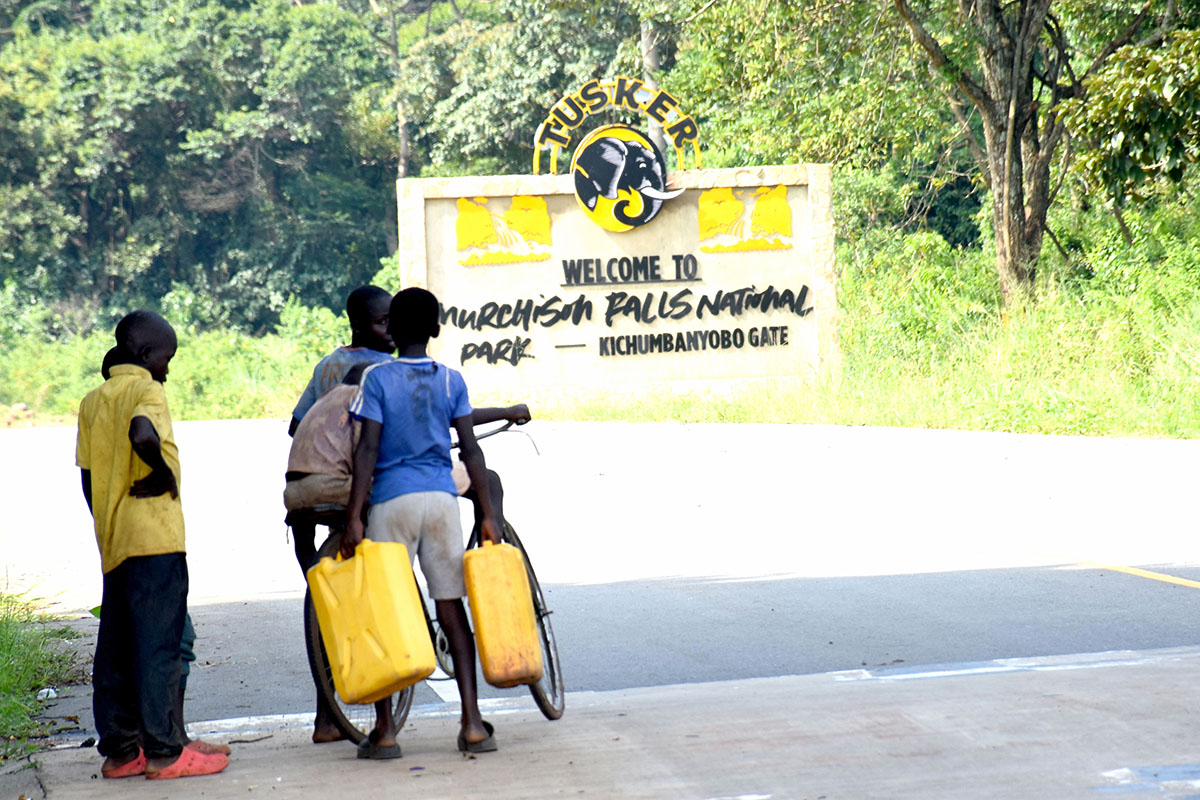
When asked whether UPDF is deployed at each of Uganda’s national parks, UWA’s Bashir Hangi confirmed their presence, saying it is part of the “interagency collaboration” intended to bolster the wildlife protection agency.
“We are thin on the ground, and we need more support,” he said. “The president decreed that the UPDF should always come and support us, so whenever we need that support, the UPDF comes and they are deployed. But when they are in the parks, they are under our command. We are the ones who tell them what to do.”
Hangi also argued that because a considerable number of Uganda’s national parks are located at the country’s border, the presence of the UPDF helps to wade off armed rebel groups such as the Lord’s Resistance Army (LRA) in the past and the Allied Democratic Forces (ADF), who have military bases in DR Congo, from using the parks to prepare to attack fight the army or civilians.
“We’ve had some cases along the South Sudan border [near Kidepo Valley National Park] where some armed people have tried to cross and come to Uganda. We didn’t allow them to cross over into the country and cause the mayhem, but that’s probably what they would have wanted to do. And this is because we work closely with the UPDF,” he said.
Uganda’s partners such as the United States have attempted to improve the capacity of the current crop of rangers through regular trainings. In early 2023, the US Special Operations Command Africa conducted a six-week “joint combined exchange training” in partnership with UWA at Queen Elizabeth National Park, near the border with DR Congo.
According to a press release from the Americans, the training “focused on teaching park rangers to counter illicit trafficking within national parks while improving the interoperability between U.S. and Ugandan forces.”
“Our hope is that each UWA Ranger will walk away with a newfound confidence to lead their subordinates against the many challenges they face,” the statement quotes Capt. King, the Course Leader from the 91st Civil Affairs Battalion, as having said. “Their ability to lead creates the space for the animals they protect, while also degrading the capabilities of malign actors which seek to do harm.”
However, the early 2025 decision by the US government under President Donald Trump to freeze foreign aid is likely to have a negative long-term impact UWA’s capacity building efforts, including the kind of trainings that Capt. King hoped would improve the rangers’ abilities to perform their wildlife protection duties while bearing in mind their responsibilities not to victimise Ugandans living near the parks.
Complaints about Overreach
The tipping of the scales towards militarisation of conservation is not everyone’s cup of tea. Dr Taddeo Rusoke, a conservation scientist at Nkumba University in Uganda, says the emphasis on a militarised approach to wildlife protection has many drawbacks, including the diversion of crucial focus and funding from more compassionate community-based coexistence between wildlife and humans.
“The main goal [of militarised conservation tactics] is to combat illegal wildlife trade and serious poaching crises using force, advanced technology like CCTVs and drones, and counterinsurgency-style operations. This approach is acknowledged to have limitations, including the entrenchment of divides between conservation authorities and local communities. It risks human rights abuses, perpetuates exclusionary practices, and makes conservation areas into conflict zones,” he reasoned.
Sentiments from some residents of villages bordering Murchison Falls National Park seem to confirm Dr Rusoke’s fears. Twenty-year-old Charles Oyaka, a resident of Luwora village in Nwoya district, says he was arrested on 19 December 2025 while grazing cattle. Oyeka claims he was grazing the animals on their family land when three park rangers arrested him, arguing that he had encroached on the park.
“At first, they took me to their post near River Ayago, where I was beaten badly. After that, I was taken to another post in Wangkwa, and later to Paraa, where I spent the night. There, I found five other people who had also been arrested. The room we slept in was small and stuffy, which made it hard for us to sleep. We had to turn in shifts at night because it was too small for all of us to fit comfortably. Before travelling to Masindi [Central Police Station], we were beaten again, and one of us even fainted,” he alleged.
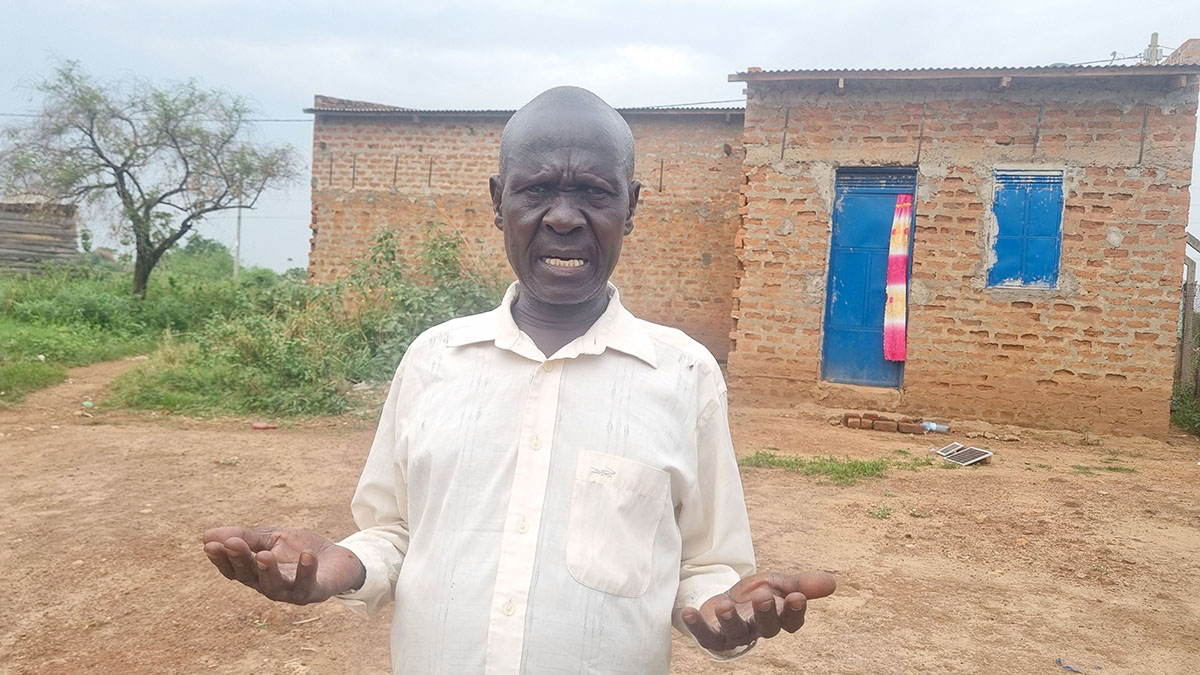
Oyaka’s father, Martin Okello, told this publication that while the local court in Masindi released his son due to lack of evidence, a court clerk withheld release documents until he was allegedly forced to pay a bribe of 500,000 Uganda Shillings (about US$135).
“My prayer is for the rangers to be exposed for their brutality against our children. Right now, my family lives in fear and can’t work in the garden because they are afraid of being mistaken for entering the park,” said Okello, a 63-year-old farmer.
Ben Okello (not related to Martin), a local councillor in Purongo Sub County, says the number of arrests has increased since UWA ramped up efforts to protect wildlife at the park using surveillance technology. However, he adds, the biggest complaints from locals are brutality by the rangers and the decision to try all wildlife cases in one court, which limits their ability to follow trials involving their loved ones.
“Recently, we held a community dialogue where we invited officials from UWA, the Police, the army, and local leaders. We wanted to understand what is happening with UWA: why there are so many reports of rangers mistreating locals. Many locals are threatening to lay barricades on all community access roads and stop selling food and other items to anyone working for UWA,” he said.
Responding to complaints by the locals, Hangi said UWA officials are only supposed to conduct their work, including surveillance and arrests within the perimeters of the park. “When we are using these drones, we are flying them over our protected areas. We don’t go to communities. We restrict ourselves to the park boundaries because we want to see what is happening along them, so communities shouldn’t get worried. They shouldn’t think that we are either spying on them. That’s not our work,” he said.
Tuheisomwe said that even if drones and other surveillance devices capture information outside the park, it is handled in confidence. “The only people who should be worried are those who are committing crimes,” she noted.
However, Kasumba conceded that UWA needs to sensitise locals about the new tech it now uses. “We’ve not gotten where we want to be in terms of sensitizing the communities to appreciate the technology we use and to embrace it,” she said. “We are still rolling out this technology, and all that is on the menu.”
But experts warn that the “if you have nothing to hide, you have nothing to fear” defense ignores the profound risks of deploying mass surveillance in highly securitized environments. As Rosaleen Duffy points out, conservationists can be dangerously naive in assuming these technologies will only be used to track wildlife criminals. Because wildlife authorities in countries like Uganda collaborate closely with the military and state security forces, those state actors are often “interested in everything that it’s recording, like literally everything”.
Furthermore, because NGO and park staff frequently lack the specialized training required to securely manage and store this sensitive data, these systems risk being co-opted. Ultimately, instead of fostering community appreciation, this digital dragnet may create a chilling effect that monitors all civilians and treats local populations as potential enemies rather than conservation partners
For Dr Rusoke, militarisation risks reversing at least 60 per cent of the social capital and trust built through community engagement programs over the last two decades. He says the long-term effectiveness of enforcement-only models is limited, with less than a 40 per cent chance of achieving sustainable conservation goals without local community buy-in, potentially leading to retaliatory killings and a lack of local support for conservation.
“The future of conservation must be built on demilitarisation and the restoration of respect, justice, and community rights,” he noted. “The path forward requires integrated, holistic management systems that co-design solutions, bridge technical innovation like early-warning systems and GPS collars with community ownership and move from donor dominance to shared leadership, a shift that is essential for conservation resilience.”
This investigation is the third part of a collaboration by Benon Herbert Oluka in Uganda, Sam Schramski in the United States, Tulani Ngwenya of Oxpeckers Investigative Environmental Journalism in South Africa and Purity Mukami in Kenya, produced with the support of the Pulitzer Center. You can read here story one and story two.